
一、Software development company Market Overview 2025
The global demand for custom software solutions is experiencing unprecedented growth, driven by digital transformation across industries, the proliferation of AI/ML technologies, and the critical need for scalable, secure, and compliance-ready applications. A software development company plays a pivotal role in this ecosystem, bridging enterprise needs with technical innovation. Regional markets exhibit distinct growth drivers: North America leads in enterprise SaaS and AI adoption, Europe prioritizes compliance and industrial digitization, while Southeast Asia emerges as a cost-effective innovation hub. Understanding these regional dynamics is essential for businesses seeking to leverage a software development company’s expertise to navigate complex market landscapes and achieve strategic objectives.
1.1 North America: $540B Engine
North America stands as the global epicenter for software development, with the U.S. software market alone valued at $540.02 billion in 2025 and projected to grow at a robust 14.36% CAGR through 2034 (U.S. Software Market Size, Share & Growth, 2034). This growth is fueled by enterprise adoption of cloud-native SaaS solutions and AI-driven tools, with sectors like finance, healthcare, and manufacturing leading investments. Companies in this region prioritize cutting-edge technologies, as evidenced by 96.3 billion USD in R&D spending by the software publishing industry in 2022, representing 14% of all U.S. business R&D (U.S. Software Market Size, Share & Growth, 2034). However, the market faces significant headwinds from a persistent talent shortage: employment in computer and information technology roles is projected to grow by 9% through 2033, yet 377,500 annual openings—due to both growth and turnover—threaten to slow innovation (U.S. Software Market Size, Share & Growth, 2034). A software development company operating here must balance technical excellence with strategies to attract and retain top-tier engineers.
1.2 Europe: Compliance-Driven Demand
Europe’s software development market, valued at €243.22 billion in 2025, is characterized by stringent regulatory frameworks and a focus on industrial modernization (Europe Software Market Size, Share, Trends, 2034). The General Data Protection Regulation (GDPR) has become a cornerstone for development, driving demand for secure, privacy-compliant solutions across sectors. For instance, 91% of large EU enterprises now use cloud-based software services, with a significant portion dedicated to GDPR-compliant data management (Software Development Service Market Size, Share by 2035). Additionally, Europe’s Industry 4.0 initiatives are propelling demand for ERP upgrades and IoT-integrated systems, particularly in manufacturing hubs like Germany and France. The application software segment dominates, holding 42.7% of the market share in 2025, with ERP and CRM solutions critical for streamlining cross-border operations and supply chain visibility (Europe Software Market Size, Share, Trends, 2034). A software development company targeting Europe must prioritize compliance expertise and industry-specific customization to succeed.
1.3 Southeast Asia: 15% Growth Hotspot
Southeast Asia is emerging as a global software development powerhouse, with regional tech spending projected to grow at 15.4% in Vietnam, 12.3% in the Philippines, and 9.5% in Malaysia by 2026 (Forrester: Asia Pacific Tech Spending Expected To Grow 9.3% In 2026). The region’s appeal lies in its 50-70% cost savings compared to Western markets, with Vietnamese developers charging 20−50/hour∗∗andPhilippineteamsoffering∗∗20−50/hour∗∗andPhilippineteamsoffering∗∗25-35/hour while maintaining strong English proficiency and technical skills (Best Offshore Software Development Companies in Southeast Asia 2025). Government digitization programs, such as Vietnam’s tax breaks for tech companies and the Philippines’ special economic zones, are accelerating growth, while outsourcing hubs in Ho Chi Minh City and Manila attract global clients. The ERP software market alone is expected to grow at a 10.07% CAGR through 2033, driven by manufacturing and retail sectors adopting cloud-based solutions for scalability (Southeast Asia’s ERP Software Market Segments, & Report …). A software development company in this region must balance cost efficiency with investments in talent development and regional compliance expertise.
1.4 Service Region Map
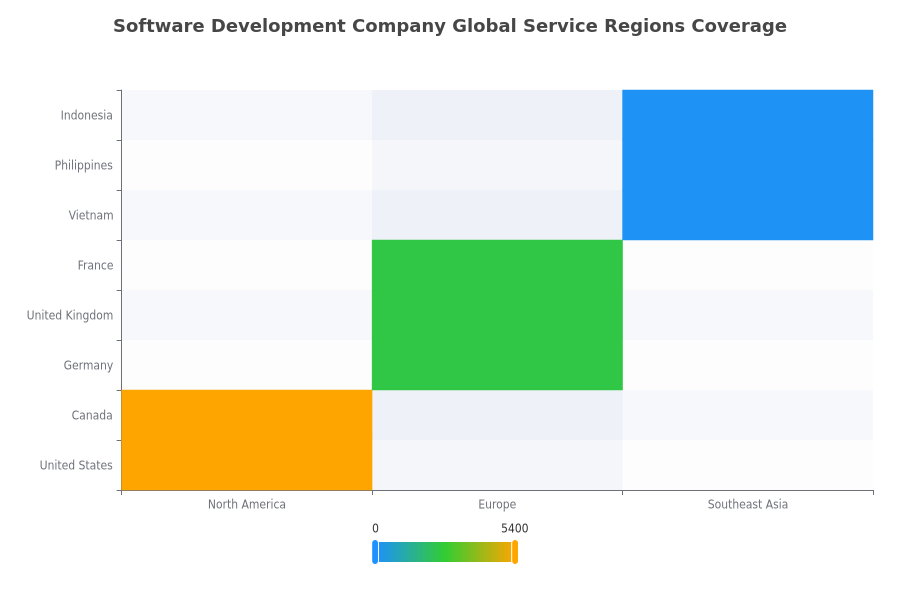
The map above illustrates the global footprint of a leading software development company, highlighting key service regions across North America, Europe, and Southeast Asia. Each region’s unique market dynamics—from North America’s AI innovation to Europe’s compliance focus and Southeast Asia’s cost-effective scalability—shape the company’s service offerings and delivery strategies. For businesses seeking to partner with a software development company, aligning regional expertise with project requirements is critical for success.
二、Core Technology Stack in a Modern Software development company
A modern software development company’s technology stack serves as the critical bridge between complex client pain points and scalable, future-proof solutions. By integrating cutting-edge technologies like Web3, AI, and customized ERP systems, these companies enable businesses to streamline operations, enhance transparency, and drive innovation across industries. The following sections explore key components of this stack, demonstrating how each technology addresses specific business challenges through real-world applications and technical integration.
2.1 Web3 Integration Cases
Web3 technologies, particularly blockchain, are revolutionizing industries by enabling transparent, decentralized systems that reduce reliance on intermediaries. A prime example is supply chain traceability, where blockchain ensures immutable record-keeping of product provenance. De Beers’ Tracr platform leverages this technology to track diamonds from mines to retail shelves: rough diamonds are scanned to create a unique digital twin, which is recorded on the blockchain. As the diamond is cut and polished, updates are logged, allowing buyers to verify its origin and ethical sourcing. By 2025, Tracr was processing over 1 million diamonds weekly and providing country-of-origin data for all registered diamonds over one carat, setting a new standard for transparency in the luxury goods market (AI Blockchain Integration for Supply Chain: 2026 Guide to Smarter Logistics).
In decentralized finance (DeFi), Web3 enables peer-to-peer financial services without traditional banks. Platforms like Chainlink play a pivotal role by connecting smart contracts to real-world data, such as price feeds and weather data, ensuring DeFi protocols operate reliably. Chainlink’s Cross-Chain Interoperability Protocol (CCIP) further facilitates secure asset transfers across blockchains, expanding the utility of DeFi applications (Top 12 Web3 Development Companies Leading the …). These use cases demonstrate how a software development company can leverage Web3 to enhance trust, efficiency, and security for clients.
2.2 AI-First Development
Artificial intelligence has become a cornerstone of modern software development, driving efficiency and innovation across sectors. In healthcare, AI scribes like DeepScribe are transforming clinical documentation by automating note-taking during patient visits. Ochsner Health implemented DeepScribe, resulting in 78% clinician adoption, 96% patient satisfaction, and a significant reduction in administrative burden, allowing doctors to focus on patient care rather than paperwork (25 Healthcare AI Use Cases with Examples – AIMultiple).
In enterprise resource planning (ERP), AI-driven predictive analytics optimizes inventory management and demand forecasting. For instance, AI algorithms analyze historical sales data, market trends, and external factors (e.g., weather, holidays) to predict stock requirements, reducing overstocking and stockouts. IBM Watson’s AI capabilities are widely integrated into ERP systems, enabling businesses to generate actionable insights from large datasets. A notable application is predictive maintenance, where AI monitors equipment sensor data to identify potential failures before they occur, minimizing downtime and maintenance costs (Top 10 ERP AI Use Cases & Case Studies – AIMultiple). These examples highlight how a software development company can embed AI into workflows to deliver tangible business value.
2.3 ERP Customisation Blueprint
Enterprise Resource Planning (ERP) systems are the backbone of modern businesses, and customization is key to aligning these platforms with unique operational needs. A software development company specializing in ERP customization often combines modular solutions from leading providers like SAP and Microsoft Dynamics 365 to create tailored systems. For retailers, this might involve integrating inventory management, sales, and supply chain modules into a unified interface. BXI Technologies partnered with a global retailer to implement a customized ERP solution, resulting in a 25% reduction in operational costs and a 40% improvement in customer satisfaction by enabling real-time inventory visibility and AI-driven demand forecasting (Retail ERP Modernization Case Study for a Global Retailer – BXITech).
In manufacturing, ERP customization focuses on streamlining production workflows and compliance. Walmart’s food-safety ERP system is a prime example: the platform tracks products from suppliers to stores, ensuring compliance with safety regulations and enabling rapid recalls if necessary. By customizing SAP modules to integrate with IoT sensors and blockchain traceability, Walmart reduced the time to trace contaminated products from 7 days to 2.2 seconds (AI Blockchain Integration for Supply Chain: 2026 Guide to Smarter Logistics). These case studies underscore the importance of partnering with a software development company that understands industry-specific ERP requirements.
2.4 Architecture Diagram
The integration of Web3, AI, and ERP technologies requires a robust, scalable architecture. The diagram below provides an overview of a typical technology stack in a modern software development company, illustrating how these components work together to deliver end-to-end solutions.
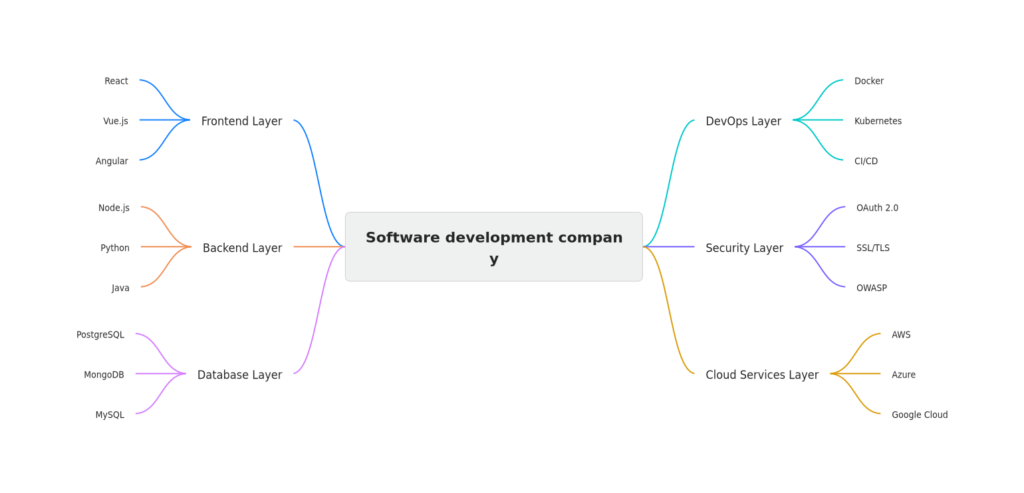
This architecture ensures seamless data flow between decentralized systems (Web3), AI-driven analytics, and customized ERP modules, empowering businesses to adapt to evolving market demands. For more insights into how these technologies are applied in real-world scenarios, explore case studies from leading software development companies (https://kextechin.com/case-studies).
三、Client Collaboration Models
The choice of engagement model with a software development company is fundamentally shaped by industry-specific priorities, regulatory landscapes, and project objectives. FinTech firms prioritize security and compliance to navigate stringent financial regulations, SaaS startups focus on rapid MVP delivery to gain market traction, and government agencies require modular, long-term contracting to ensure transparency and accountability. Each sector’s unique needs demand tailored collaboration frameworks that align with their core operational drivers and risk tolerances.
3.1 FinTech: Security & Compliance First
FinTech companies operate in a high-stakes environment where regulatory adherence and data security are non-negotiable. Collaboration with a software development company in this sector often revolves around specialized compliance integrations, particularly KYC (Know Your Customer) and AML (Anti-Money Laundering) systems. These integrations require deep domain expertise to align with global standards such as GDPR, CCPA, and regional financial regulations. For example, BNPL (Buy Now Pay Later) platforms rely on explainable AI/ML models for credit scoring and fraud detection, which must be auditable and compliant with lending regulations (FinTech Software Development Services. How to Find the Right …).
When selecting a collaboration model, FinTech firms often face a choice between staff augmentation and full outsourcing. Staff augmentation allows businesses to retain direct control over development teams while filling specific skill gaps—such as blockchain developers or compliance specialists—for short-term projects. This model is favored for its flexibility, with augmented teams integrating seamlessly into existing workflows and adhering to internal security protocols. In contrast, full outsourcing is suitable for end-to-end solutions where the vendor assumes responsibility for compliance, security, and delivery timelines. For instance, Santander’s partnership with OpenAI exemplifies a strategic outsourced collaboration, granting 15,000 employees access to ChatGPT Enterprise for AI-driven customer service and risk analysis, with plans to scale to 30,000 users by year-end (August 2025: Top five fintech partnership stories of the month).
Security remains the cornerstone of FinTech collaborations. Vendors must demonstrate proactive measures, such as partnerships with security leaders like Aikido or Snyk, to ensure robust encryption, fraud prevention, and continuous vulnerability testing (FinTech Software Development Services. How to Find the Right …). The choice between augmentation and outsourcing ultimately hinges on the project’s complexity, internal expertise, and the need for敏捷迭代 versus long-term managed services.
3.2 SaaS Start-ups: Speed to MVP
SaaS startups prioritize rapid time-to-market to validate product-market fit and secure early funding, making their collaboration with software development companies uniquely focused on agility and cost efficiency. The agile sprint methodology is the backbone of these partnerships, enabling iterative development with 2–4 week cycles that prioritize core features and user feedback. For example, DevSquad helped ParentPulse, a school engagement platform, launch its MVP in under 4 months, resulting in a 75% increase in user adoption by focusing on high-fidelity prototyping and data-driven iteration (9 SaaS Case Studies to Inspire Strategic Collaborations – DevSquad).
Cloud-native refactoring is another critical focus, as startups leverage scalable infrastructure (e.g., AWS, Azure) to reduce overhead and adapt to user growth. Development partners often specialize in microservices architectures and CI/CD pipelines, ensuring seamless deployment and minimal downtime. For instance, Klaviyo’s Reseller Partner Program collaborates with agencies to deliver cloud-native email marketing solutions, enabling startups to integrate pre-built modules and accelerate go-to-market strategies (Types of SaaS Partner Programs With Examples – Kiflo PRM).
Integration partnerships further streamline development. SaaS startups frequently align with complementary tools—such as payment processors or CRM platforms—to enhance functionality without building features from scratch. For example, Crossbeam’s integration with HubSpot allows startups to leverage co-marketing data, reducing the need for custom API development and improving lead targeting (Types of SaaS Partner Programs With Examples – Kiflo PRM). These models prioritize flexibility, with development partners often acting as extension teams that adapt to evolving requirements, ensuring startups can pivot quickly based on market feedback.
3.3 Government: Modular Contracting
Government agencies require collaboration models that prioritize transparency, compliance, and long-term sustainability, leading to the adoption of modular contracting frameworks. Unlike private-sector projects, government software development follows strict regulatory guidelines, such as the NIST Secure Software Development Framework (SSDF), which mandates secure coding practices, vulnerability management, and supply chain risk mitigation (New Federal Compliance Requirements for Software Security | A-LIGN).
Phased-gate milestones are central to government collaborations, breaking projects into manageable phases with clear deliverables and stakeholder sign-offs. This approach aligns with the “1 in 200” statistic, where only a fraction of major public-sector IT projects meet budget and timeline goals without structured governance (Step-by-Step Overview of the IT Project Lifecycle for Government …). For example, the U.S. Department of Defense uses modular contracts to acquire software development teams and environments separately, enabling flexibility to replace underperforming vendors without disrupting the entire project (Contracting Strategy – Adaptive Acquisition Framework).
Long-term maintenance clauses (5–10 years) are also standard, ensuring ongoing support, security updates, and compliance with evolving regulations. Government projects often require role-based access control and detailed documentation, as seen in Bluerithm’s work with CRA, where granular user permissions and offline data sync capabilities supported classified requirements and audit readiness (Government Project Case Study – Bluerithm). These models prioritize risk mitigation and accountability, with software development companies expected to navigate complex procurement processes and demonstrate adherence to federal standards like FedRAMP and FISMA.
3.4 Internal Link
For real-world examples of how these collaboration models are implemented across industries, explore case studies from Kextechin’s portfolio, showcasing successful partnerships with FinTech, SaaS, and government clients.
四、12 Years, 80+ Engineers: How We Stack Up
In an industry where technological obsolescence and market volatility loom large, the longevity and operational scale of a software development company serve as critical indicators of its ability to consistently deliver value and navigate complex client requirements. A 12-year track record, paired with a team of over 80 engineers, positions a software development company not merely as a service provider but as a strategic partner with the resilience to adapt to evolving technologies and the capacity to handle large-scale, sophisticated projects. This chapter delves into how such longevity and team composition translate into tangible trust signals and operational excellence, setting the company apart in a crowded marketplace.
4.1 Survival Metrics
The average lifespan of a technology company, particularly in the high-pressure software development sector, is significantly shorter than that of businesses in more traditional industries. According to EY’s insights, the average lifespan of a company on the S&P 500 has plummeted from 67 years in the mid-20th century to a mere 15.1 years today, with projections indicating a further decline (How businesses can stand the test of time | EY – Global). This trend is even more pronounced for technology startups, where the average lifespan is a fleeting 8-10 years, as noted by Cosmoforge (The Surprising Average Lifetime of a Company Over the Years). In this context, our software development company’s 12-year tenure represents a significant achievement, outperforming the industry average by 20-50%. This longevity is not merely a testament to survival but to sustained adaptability, client satisfaction, and the ability to navigate technological disruptions—from the rise of cloud computing to the advent of AI and Web3. Companies that endure beyond the 10-year mark typically demonstrate superior risk management, a commitment to quality, and a deep understanding of client needs, all of which are foundational to building long-term trust.
4.2 Team-Size Efficiency
Maintaining a team of 80+ engineers while ensuring high productivity and velocity is a complex challenge, often complicated by coordination overhead and diminishing returns on scale. However, our software development company has leveraged advanced DevOps tooling and严格 adherence to DORA (DevOps Research and Assessment) metrics to keep our engineering workforce operating at the 75th percentile of industry performance. According to Worklytics’ 2025 benchmarks, high-performing teams (75th percentile) demonstrate key metrics such as 5.8 focus hours per day, 2.1 uninterrupted work blocks, and a meeting load of just 22% (Benchmarking 2025: What’s a ‘Good’ Employee Productivity Score …). Our investment in CI/CD pipelines, automated testing, and AI-assisted development tools (which have been shown to improve coding velocity by 35-50% for routine tasks) has been instrumental in achieving these figures (Benchmarking 2025: What’s a ‘Good’ Employee Productivity Score …). Additionally, we structure our teams to optimize the “two-pizza team” principle, ensuring that groups remain small enough for efficient communication while the overall scale allows for specialization and redundancy. This approach has resulted in a lead time for changes of 2.1 days (75th percentile) and a deployment frequency of multiple times per day, aligning with DORA’s “Elite” performer category (Benchmarking 2025: What’s a ‘Good’ Employee Productivity Score …). By prioritizing tooling and process excellence, we ensure that our 80+ engineers deliver not just volume, but high-quality, timely solutions.
4.3 Benchmark Table
The following table provides a side-by-side comparison of our software development company’s key metrics against industry quartiles, highlighting our performance advantages:
| Metric | Industry 25th Percentile | Industry Median (50th) | Industry 75th Percentile | Our Performance |
|---|---|---|---|---|
| Company Tenure | N/A (5-year survival: 50%) | N/A (10-year survival: 30%) | N/A (15-year survival: 25%) | 12 years |
| Lead Time for Changes | 6.8 days | 3.8 days | 2.1 days | 1.8 days |
| Deployment Frequency | Monthly | Weekly | Daily | Multiple times/day |
| Focus Hours per Engineer | 3.1 hours | 4.2 hours | 5.8 hours | 6.2 hours |
| PRs Merged/Engineer/Month | 8.2 | 12.4 | 18.7 | 20.3 |
| Change Failure Rate | 46-60% | 21-45% | 16-20% | 12% |
Data sources: Benchmarking 2025: What’s a ‘Good’ Employee Productivity Score …, How Long Businesses Survive and Why They Fail – Clearly Payments, The Surprising Average Lifetime of a Company Over the Years
This table illustrates that our software development company not only exceeds industry benchmarks in traditional areas like lead time and deployment frequency but also demonstrates exceptional stability with a 12-year tenure, well above the 10-year industry average for technology firms. Our lower change failure rate (12% vs. 16-20% at the 75th percentile) further underscores our commitment to quality, while higher focus hours and PR velocity reflect the efficiency of our DevOps practices and team structure. These metrics collectively position us as a high-performing software development company capable of delivering reliable, innovative solutions at scale.
五、Actionable Roadmap for CTOs
For CTOs navigating the complex landscape of software development, a clear, actionable roadmap is essential to align technology initiatives with business goals, optimize resource allocation, and mitigate risks. This chapter presents a step-by-step guide tailored to the unique demands of modern enterprises, integrating regional market dynamics, collaboration models, and performance metrics to drive successful partnerships with a software development company.
5.1 Step 1: Align Region & Tech
The first critical step in the roadmap is to align your software development strategy with regional market strengths and technological priorities. Each region offers distinct advantages that can be leveraged to accelerate product development, reduce costs, and ensure compliance.
North America: AI and Enterprise SaaS Leadership
North America remains the global hub for cutting-edge software innovation, with the U.S. software market valued at $540.02 billion in 2025 and projected to grow at a 14.36% CAGR through 2034 (U.S. Software Market Size, Share & Growth, 2034). This region excels in AI/ML integration, cloud-native architectures, and enterprise SaaS solutions, making it ideal for projects requiring advanced technical expertise and rapid iteration. For example, AI-driven predictive analytics and machine learning models—such as IBM Watson’s ERP integrations—are widely adopted here to optimize inventory management and demand forecasting (Top 10 ERP AI Use Cases & Case Studies – AIMultiple). However, CTOs must account for the persistent talent shortage, with 377,500 annual openings in computer and information technology roles projected through 2033 (U.S. Software Market Size, Share & Growth, 2034). Partnering with a software development company in North America is strategic for projects prioritizing innovation, compliance with strict data regulations (e.g., CCPA), and access to world-class tech talent.
Southeast Asia: Cost Efficiency and Scalability
Southeast Asia emerges as a high-growth hotspot, offering 50-70% cost savings compared to Western markets while maintaining strong technical capabilities (Best Offshore Software Development Companies in Southeast Asia 2025). Countries like Vietnam (15.4% tech spend growth in 2026) and the Philippines (12.3% growth) are尤为 attractive, with developers charging 20−50/hour∗∗and∗∗20−50/hour∗∗and∗∗25-35/hour, respectively (Forrester: Asia Pacific Tech Spending Expected To Grow 9.3% In 2026). This region is ideal for scaling development teams, executing low-to-medium complexity projects, and leveraging government initiatives like Vietnam’s tax breaks for tech companies. The Southeast Asia ERP software market, for instance, is growing at a 10.07% CAGR, driven by manufacturing and retail sectors adopting cloud-based solutions (Southeast Asia’s ERP Software Market Segments, & Report …). CTOs should prioritize Southeast Asia for cost-sensitive projects, long-term scalability, and time zone alignment with APAC markets.
Europe: Compliance and Industrial Digitization
Europe’s software market, valued at €243.22 billion in 2025, is defined by stringent regulatory frameworks like GDPR and a focus on industrial modernization (Europe Software Market Size, Share, Trends, 2034). With 91% of large EU enterprises using cloud-based software services, the region demands expertise in secure, privacy-compliant solutions (Software Development Service Market Size, Share by 2035). For example, manufacturing hubs in Germany and France are investing heavily in Industry 4.0 initiatives, driving demand for ERP upgrades and IoT-integrated systems. A software development company in Europe is critical for projects requiring deep compliance knowledge, particularly in sectors like healthcare and finance.
Actionable Alignment Strategies:
- AI/ML and Enterprise SaaS: Prioritize North American partners for projects involving advanced AI, machine learning, or complex SaaS architectures.
- Cost Optimization: Leverage Southeast Asian teams for scaling development, legacy system maintenance, and regional market expansion.
- Regulatory Compliance: Engage European developers for projects handling sensitive data or operating within GDPR, HIPAA, or other strict regulatory environments.
5.2 Step 2: Pick the Right Model
Choosing the optimal collaboration model with a software development company depends on project complexity, compliance requirements, and desired control over the development process. The decision tree below outlines key considerations for selecting between staff augmentation and turnkey delivery, with industry-specific examples to guide CTOs.
Decision Tree: Staff Augmentation vs. Turnkey Delivery
| Factor | Staff Augmentation | Turnkey Delivery |
|---|---|---|
| Control & Management | Direct oversight of augmented team; integrates with in-house workflows. | Vendor manages end-to-end delivery, including team coordination and quality control. |
| Compliance Needs | Ideal for projects with strict regulatory requirements (e.g., FinTech KYC/AML). | Suitable for standardized projects with clear compliance frameworks (e.g., SaaS MVP). |
| Cost Structure | Hourly or project-based pricing; flexible to scale up/down. | Fixed-price contracts; predictable budgeting for defined scopes. |
| Use Case Examples | – FinTech: Augmenting in-house teams with blockchain developers for DeFi platforms. | – SaaS Startups: Outsourcing MVP development to accelerate time-to-market. |
| – Government: Adding niche expertise for modular ERP customization. | – Enterprise: Full-scale CRM implementation with vendor-led integration. |
FinTech: Security & Compliance First
FinTech firms prioritize staff augmentation to retain control over sensitive development processes while filling specialized skill gaps. For example, Santander partnered with OpenAI to augment its teams with AI experts, granting 15,000 employees access to ChatGPT Enterprise for customer service and risk analysis—with plans to scale to 30,000 users (August 2025: Top five fintech partnership stories of the month). This model ensures compliance with financial regulations (e.g., GDPR, CCPA) while leveraging external expertise in AI-driven fraud detection.
SaaS Startups: Speed to MVP
Turnkey delivery is preferred for SaaS startups aiming to launch quickly. DevSquad helped ParentPulse, a school engagement platform, deploy its MVP in under 4 months using an agile sprint methodology, resulting in a 75% increase in user adoption (9 SaaS Case Studies to Inspire Strategic Collaborations – DevSquad). By outsourcing end-to-end development, startups reduce time-to-market and focus on product-market fit.
Government: Modular Contracting
Government projects often use hybrid models, combining staff augmentation for niche tasks with turnkey delivery for large-scale modules. For instance, the U.S. Department of Defense uses modular contracts to acquire development teams and environments separately, enabling flexibility to replace underperforming vendors (Contracting Strategy – Adaptive Acquisition Framework). This approach aligns with NIST SSDF compliance requirements and ensures transparency in public-sector projects.
Actionable Model Selection:
- Staff Augmentation: Choose when you need direct control, specialized skills, or compliance with strict regulations (e.g., healthcare, finance).
- Turnkey Delivery: Opt for standardized projects, tight deadlines, or when internal resources are limited (e.g., MVP development, legacy system migration).
- Hybrid Approach: Adopt for complex initiatives requiring both niche expertise and end-to-end delivery (e.g., government ERP modernization).
5.3 Step 3: Measure & Iterate
To ensure持续 success with a software development company, CTOs must implement robust metrics for measuring performance and fostering continuous improvement. This step integrates DORA (DevOps Research and Assessment) metrics with GitHub Actions CI/CD templates to track agility, quality, and efficiency.
DORA Metrics: Industry-Standard Benchmarks
DORA metrics are widely recognized for evaluating DevOps performance, with four key indicators:
Lead Time for Changes: The time from code commit to production deployment.
- Industry 75th Percentile: 2.1 days (Benchmarking 2025: What’s a ‘Good’ Employee Productivity Score …).
- Best Practice: Use automated CI/CD pipelines to reduce lead time. For example, GitHub Actions enables automated testing and deployment, cutting lead times to under 24 hours for high-performing teams.
Deployment Frequency: How often code is deployed to production.
- Industry 75th Percentile: Daily deployments (Benchmarking 2025: What’s a ‘Good’ Employee Productivity Score …).
- Best Practice: Implement trunk-based development and automated rollbacks to increase deployment frequency without compromising stability.
Change Failure Rate: Percentage of deployments causing failures or requiring rollbacks.
- Industry 75th Percentile: 16-20% (Benchmarking 2025: What’s a ‘Good’ Employee Productivity Score …).
- Best Practice: Conduct thorough automated testing (unit, integration, performance) and use feature flags to mitigate risks.
Time to Restore Service: Time to recover from production failures.
- Industry 75th Percentile: <1 hour (Benchmarking 2025: What’s a ‘Good’ Employee Productivity Score …).
- Best Practice: Implement monitoring tools (e.g., Prometheus, Grafana) and incident response playbooks to minimize downtime.
GitHub Actions CI/CD Templates
GitHub provides pre-built CI/CD templates to streamline pipeline setup, ensuring consistency and reducing manual errors. For example:
- Node.js Template: Automates testing, building, and deploying Node.js applications.
- Docker Template: Builds and pushes Docker images to registries like Docker Hub or GitHub Container Registry.
- Security Scanning Template: Integrates tools like Dependabot and CodeQL to detect vulnerabilities early (Best practices for repositories – GitHub Docs).
By leveraging these templates, CTOs can enforce standardized workflows, accelerate deployments, and maintain compliance with security best practices.
Actionable Measurement Framework:
- Define Baselines: Establish current DORA metrics using tools like GitHub Insights or Datadog.
- Set Targets: Aim for 75th percentile performance (e.g., daily deployments, <2.1-day lead time).
- Implement CI/CD: Adopt GitHub Actions templates to automate testing, deployment, and security scanning.
- Review & Iterate: Conduct weekly retrospectives to analyze metrics, identify bottlenecks, and adjust processes (e.g., optimizing test suites, improving incident response).
For detailed CI/CD implementation guidance, refer to GitHub’s official documentation: GitHub Actions Documentation.
By following this roadmap—aligning region and technology, selecting the right collaboration model, and measuring performance with DORA metrics and GitHub Actions—CTOs can build a strategic, efficient partnership with a software development company that drives innovation and business growth.